
Enabling Civil Society in Development and Humanitarian Assistance
OECD Recommendation on Enabling Civil Society in Development Co-operation and Humanitarian Assistance
Published July 2021, Updated January 2026
The DAC Recommendation on Enabling Civil Society in Development Cooperation and Humanitarian Assistance is the first international standard focused on the actions of providers to enhance their collaboration with civil society actors as contributors to the 2030 Agenda and to strengthening democracy. It provides a framework to support, guide and incentivize development co-operation and humanitarian assistance providers in advancing their policies and practices in ways that reinforce civic space and civil society actors, at home as well as in partner countries.
The OECD Development Assistance Committee (DAC) adopted the Recommendation on 6 July 2021. The DAC Recommendation was developed through an extensive consultation process with the 30 DAC member countries, within the OECD, and with other stakeholders including the DAC-CSO Reference Group.
Read ICNL’s post on how donors can take immediate action to implement the Recommendation’s provisions here.
In December 2021, ICNL, together with the OECD Development Co-operation Directorate and the Swedish International Development Cooperation Agency (Sida), convened partners at the OGP Global Summit to discuss opportunities to use the OGP process to advance implementation of the Recommendation. You can view the full video of the session here.
Key Findings from a Survey of the DAC-CSO Reference Group
In April and May 2023, ICNL co-led the administration of a survey of civil partners, to identify key initiatives by donors and civil society to implement the Recommendation. A two-pager summarizing the survey results can be found here.
Enabling Civil Society and Civic Space in a Changing Landscape
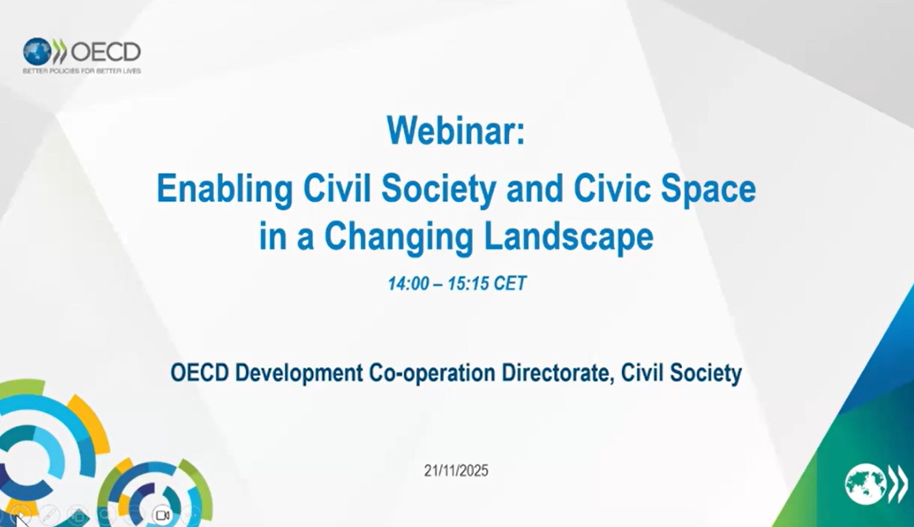
An empowered and enabled civil society is critical to effective development co-operation. The OECD DAC Recommendation on Enabling Civil Society in Development Co-operation offers valuable principles for how donors and civil society can work together to support an enabling environment: by prioritizing civic space, increasing support to local civil society actors, consulting with civil society on how to navigate changes to aid programs, and strengthening civil society governance and the enabling fiscal environment for civil society. To learn more, explore the OECD’s 2025 webinar “Enabling Civil Society and Civic Space in a Changing Landscape,” in which ICNL participated.
Five Years In: Civil Society Views on the DAC Recommendation
In 2026, the DAC will conclude its review of how the Recommendation has been implemented during its first five years. To inform this process, the DAC conducted a survey in late 2025 of civil society partners (in tandem with a survey of DAC provider adherents), to gather their perspectives on the Recommendation’s implementation and continued relevance. Together with partners from the DAC CSO Reference Group, ICNL prepared a summary report highlighting the survey’s key findings.
Sign up for our newsletters
Sign up